
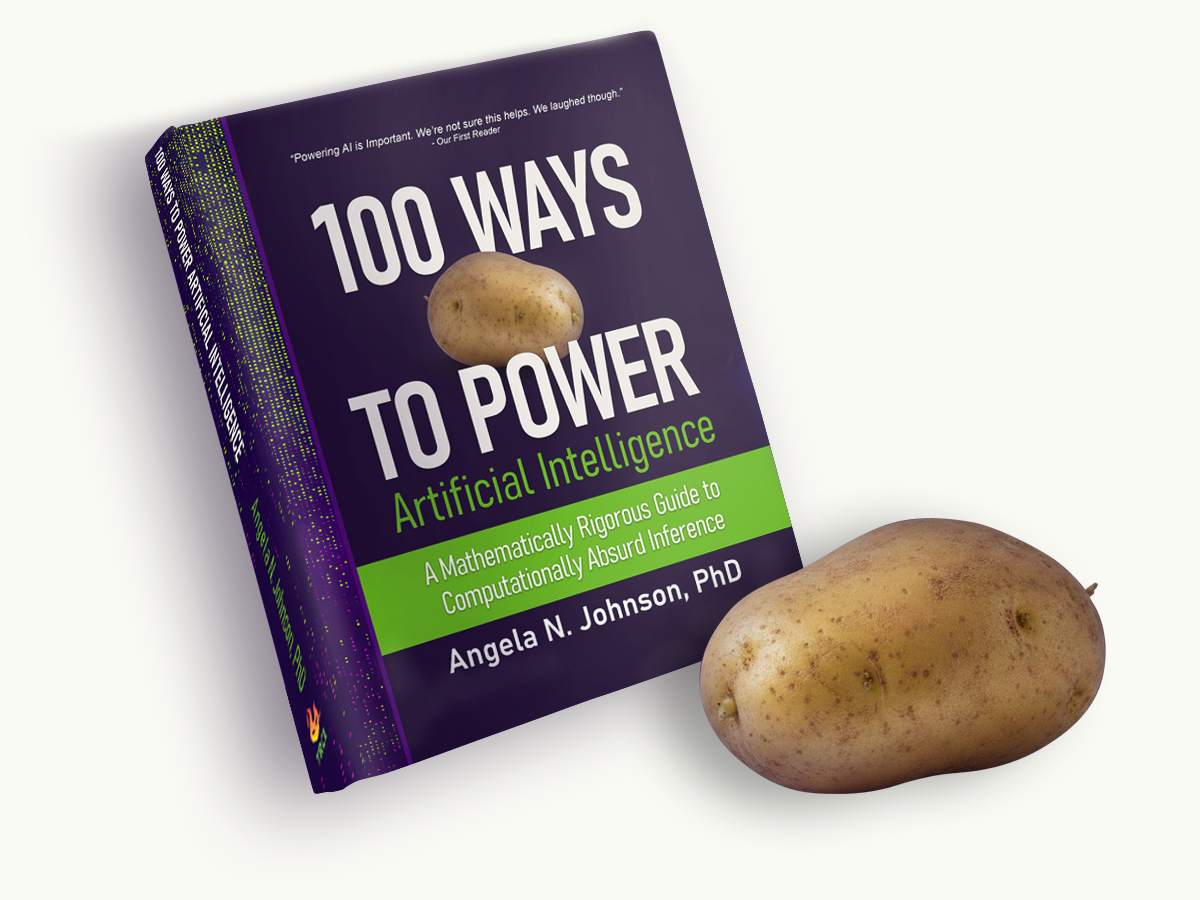
A Mathematically Rigorous Guide to Computationally Absurd Inference
Can AI run on potatoes? On cat static? On hamster wheels? On the heat death of the universe? This book takes you through 100 power sources and asks a simple question for each one. The math is real. The sources are peer-reviewed. The premise is absolutely not.
No potatoes were harmed in the making of this book, though 300,000 were theoretically inconvenienced.
175 pages · Hardcover $39.95 · Ebook $19.95
What is in the book
100 chapters across four sections, each asking whether a specific power source can run AI. From ancient engineering to cosmic speculation, with real math and real citations throughout.
Historical Compute
Baghdad batteries, Antikythera mechanisms, mechanical looms, slide rules, TI-82 calculators, Nokia brick phones, prayer wheels
Biological Compute
Cat static, hamster wheels, electric eels, whale songs, bee swarms, fireflies, mushrooms, slime molds
The Body as Compute
Snoring, body heat, chewing, bike pedaling, dance steps, clapping, typing, human waste
Earth and Cosmic Compute
Raindrops, volcanic lightning, ocean tides, coffee grounds, cheese, micronuclear reactors, Dyson spheres, neutron stars
What people are saying
“Powering AI is important. We’re not sure this helps. We laughed though.”
“That was insane, in a good way.”
“…the thing that makes it work is that it’s simultaneously stupid and profound.”
“It’s a Trojan Horse for Digital Literacy.”
“This book looks like the love child of a serious PhD thesis and a late-night shitpost that somehow got typeset in LaTeX. I’m obsessed.”
“Power, compute, infrastructure, and access are all political and material, and the distance between absurdity and viability is much smaller than industry mythology wants people to think.”
About the author
Angela N. Johnson, PhD, has spent two decades figuring out what happens when new technology meets old regulations. She serves as SVP of Advisory Services at Avania, teaches at Northeastern University, and founded The Real Cat Labs to bridge the gap between AI research and public understanding. She is apparently unclear whether this website is serious education, cutting-edge engineering, or performance art. It is all of them.
More about usThe Real Cat Labs, Inc. is a 501(c)(3) nonprofit. EIN 41-3537370.
Proceeds from book sales support research and education on machine cognition and human-AI interaction.