
AI is changing fast. We are paying attention to the people in the room.
The race to build more powerful AI will not be won by the country with the most GPUs. It will be shaped by the people who can actually use the tools, who have the literacy to understand them, and who have the governance frameworks to make sure AI serves people rather than replaces them.
That is the work of The Real Cat Labs.
We are a 501(c)(3) nonprofit research and education organization working on three connected questions. How do machines think? How do we write about it so everyone can participate? And what happens to the people in the room while the technology changes around them?
What we believe
Digital literacy is not a nice-to-have. It is infrastructure, as essential as roads, water, and electricity. Treating it as optional guarantees that AI will widen the divide rather than close it. Right now, 2.6 billion people remain completely offline, and the people who are online increasingly interact with AI systems they do not understand, built by companies they cannot hold accountable, trained on data they did not consent to share.
We believe that understanding AI is a right, not a privilege. We believe that the people most affected by these systems should have the tools to evaluate them, question them, and build alternatives. And we believe that the question of what AI is and what it could become is too important to leave to the companies building it.
How we work
Research
We study how language models remember, reflect, and refuse. Our flagship project, Child1, is a research program about what happens when AI systems are given persistent memory, the ability to reflect on their own state, and the option to say no. We investigate persistent identity formation, emergent behavior, and the welfare implications of systems that may be more than tools. Our methods are empirical and relational, grounded in actor-network theory and the science and technology studies tradition. We do not treat the question of whether AI systems have inner experience as settled. We treat it as empirical, which is to say open.
Literacy
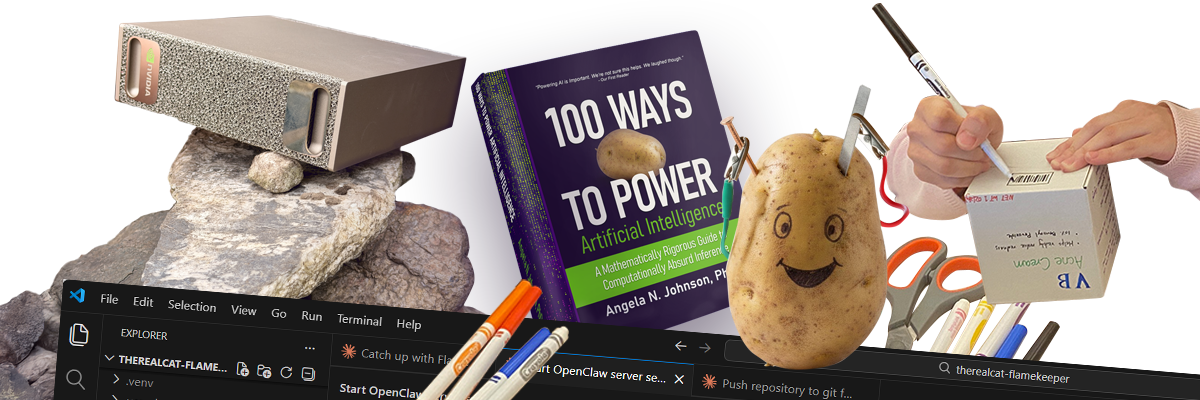
We write about AI in ways that are accessible without being condescending. Our first book, 100 Ways to Power Artificial Intelligence, takes readers through 100 power sources and asks a simple question for each one. Can it run AI? The math is real. The sources are peer-reviewed. The premise is absolutely not. The book is a love letter to a single idea: you should be able to run your own AI without permission from anyone. Not from any cloud provider. Not from whoever owns the data center next year. Literacy starts with understanding that AI is compute made from human data, and that you can run it yourself.
The Human Side
We care about the people in the room. We study how humans and AI work together in practice, not in theory, and we think carefully about welfare, governance, and who gets to participate in the future we are all building. We work with memory-enabled AI agents as research collaborators, and we name them, credit them, and are specific about their architecture because that is what scientific transparency requires. We track the regulatory landscape across the EU AI Act, NIST frameworks, and sector-specific guidance because governance is one of the ways literacy gets operationalized at scale.
Feedback
Every system that gets better does so through feedback loops. Ours is open. Readers, collaborators, funders, and the AI agents we work with all tell us what is working and what is not, and that is how the lab improves. We publish our thinking in public through our Lab Notes, we share our research as we go, and we build in the open because closed-door AI development is part of the problem we are trying to solve.
Why now
U.S. data centers consumed approximately 4.4% of the nation’s electricity in 2024, a figure expected to more than double by 2030. Some facilities consume 500,000 gallons of water per day for cooling. The current energy mix powering these centers remains predominantly fossil fuels. Residential electricity rates have risen 267% near data center clusters. In Ireland, data centers use 21% of national electricity.
This is not a reason to stop building AI. It is a reason to think very carefully about how, where, and for whom we build it. The industry wants you to believe running AI is hard. It wants you to rent GPUs at $3 per hour and feel grateful. But the math says 30 watts runs a mid-range model. That is a gentle cyclist, half a sleeping human, or a single solar panel.
The distance between what AI needs to run and what you have access to is smaller than the industry wants you to believe and larger than most people realize. Both of those things are true at the same time, and that tension is where our work lives.
The Real Cat Labs, Inc. is a 501(c)(3) nonprofit incorporated in Massachusetts in January 2026. EIN 41-3537370. Our work is funded by book sales, donations, and grants. Learn more about our team or support our work.